ENCORE
Friday October 30, 2026 at 7:30 pm
Friday October 30, 2026 at 7:30 pm
Guelph Youth Music Centre Recital Hall
75 Cardigan Street, Guelph, ON
75 Cardigan Street, Guelph, ON
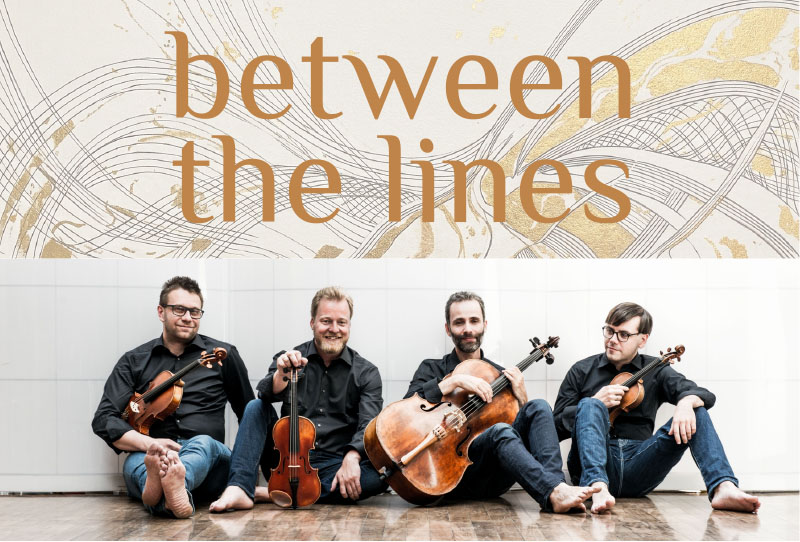
ZEMLINSKY QUARTET
František Souček violin
Petr Střížek violin
Petr Holman viola
Vladimír Fortin cello
Petr Střížek violin
Petr Holman viola
Vladimír Fortin cello
Smetana String Quartet No. 2 in D minor
Bartók String Quartet No. 2, Op. 17
Beethoven String Quartet in F major, Op. 18, No. 1
Bartók String Quartet No. 2, Op. 17
Beethoven String Quartet in F major, Op. 18, No. 1
’’Some of the most powerful string quartets say as much between the notes as within them. This program brings together three works where personal confession, folk memory, and historical upheaval quietly shape the music from behind the scenes.
Beethoven’s Quartet in F major, Op. 18, No. 1 opens the evening with a private literary key hidden inside a public genre. Beethoven sent an early draft to his friend Karl Amenda annotated with cryptic French phrases — “il se rend au tombeau,” “le désespoir,” “il se tue” — mapping the slow movement onto the tomb scene from Romeo and Juliet. When Amenda later recalled that the Adagio had pictured for him “the parting of two lovers,” Beethoven confirmed it outright: “I thought of the scene in the burial vault.” That confession never appeared in the score itself, and Beethoven soon asked Amenda to keep the earlier version private, having reworked the whole quartet so thoroughly that, as he wrote, “only now have I learned how to write quartets properly”. What audiences hear is abstract chamber music; beneath it lies a specific, unspoken drama.
Bartók’s Quartet No. 2, Op. 17 carries its history more obliquely. Written between 1915 and 1917, it was composed almost entirely during the First World War, a conflict that sealed Hungary’s borders and abruptly ended the folk-song-collecting expeditions across the Balkans and North Africa that had defined Bartók’s musical identity. Cut off from that fieldwork, he turned inward: the quartet’s three movements move from settled lyricism through violent, capricious energy to a lament-like close, and traces of the modal folk melodies he could no longer go out and gather resurface instead as memory, absorbed so completely into his harmonic language that they read less as quotation than as native vocabulary. Commentators have described the piece as sitting on a hinge between two eras — Bartók’s own stylistic development and the collapse of the old European order happening around him — without ever depicting either literally.
Smetana’s Quartet No. 2 in D minor closes the program as the most nakedly personal of the three, though it resists easy narration. Written in 1882–83, a decade after the total deafness (now attributed to neurosyphilis) that had already ended his conducting career, it was composed against his doctors’ explicit orders that he abstain from music altogether. Unlike his First Quartet, “From My Life,” which Smetana annotated with an explicit program describing his hearing loss, the Second Quartet offers no key to its meaning — only fragmented phrases, restless harmonic turns, and, unexpectedly, a bright polka amid the turbulence. Contemporaries described it as “a swirl of music of a person who has lost his hearing”: not a description of illness, but its direct symptom, audible in the music’s very construction.
Taken together, the three quartets trace a single idea from three different angles — a hidden text, a silenced tradition, and an unspoken illness — each shaping the music from behind the scenes rather than announcing itself on the surface.
Beethoven’s Quartet in F major, Op. 18, No. 1 opens the evening with a private literary key hidden inside a public genre. Beethoven sent an early draft to his friend Karl Amenda annotated with cryptic French phrases — “il se rend au tombeau,” “le désespoir,” “il se tue” — mapping the slow movement onto the tomb scene from Romeo and Juliet. When Amenda later recalled that the Adagio had pictured for him “the parting of two lovers,” Beethoven confirmed it outright: “I thought of the scene in the burial vault.” That confession never appeared in the score itself, and Beethoven soon asked Amenda to keep the earlier version private, having reworked the whole quartet so thoroughly that, as he wrote, “only now have I learned how to write quartets properly”. What audiences hear is abstract chamber music; beneath it lies a specific, unspoken drama.
Bartók’s Quartet No. 2, Op. 17 carries its history more obliquely. Written between 1915 and 1917, it was composed almost entirely during the First World War, a conflict that sealed Hungary’s borders and abruptly ended the folk-song-collecting expeditions across the Balkans and North Africa that had defined Bartók’s musical identity. Cut off from that fieldwork, he turned inward: the quartet’s three movements move from settled lyricism through violent, capricious energy to a lament-like close, and traces of the modal folk melodies he could no longer go out and gather resurface instead as memory, absorbed so completely into his harmonic language that they read less as quotation than as native vocabulary. Commentators have described the piece as sitting on a hinge between two eras — Bartók’s own stylistic development and the collapse of the old European order happening around him — without ever depicting either literally.
Smetana’s Quartet No. 2 in D minor closes the program as the most nakedly personal of the three, though it resists easy narration. Written in 1882–83, a decade after the total deafness (now attributed to neurosyphilis) that had already ended his conducting career, it was composed against his doctors’ explicit orders that he abstain from music altogether. Unlike his First Quartet, “From My Life,” which Smetana annotated with an explicit program describing his hearing loss, the Second Quartet offers no key to its meaning — only fragmented phrases, restless harmonic turns, and, unexpectedly, a bright polka amid the turbulence. Contemporaries described it as “a swirl of music of a person who has lost his hearing”: not a description of illness, but its direct symptom, audible in the music’s very construction.
Taken together, the three quartets trace a single idea from three different angles — a hidden text, a silenced tradition, and an unspoken illness — each shaping the music from behind the scenes rather than announcing itself on the surface.
KW Chamber Music Society
Thursday October 29, 2026 at 7 pm
Location tba
Thursday October 29, 2026 at 7 pm
Location tba
more information HERE
Emil Burian String Quartet No. 4
Janáček String Quartet “Youth” (an arrangement of his wind sextet, “Youth”)
Dvořák String Quartet in F major, Op. 96 (“American”)
Janáček String Quartet “Youth” (an arrangement of his wind sextet, “Youth”)
Dvořák String Quartet in F major, Op. 96 (“American”)
KW Chamber Music Society
Saturday November 1, 2026 at 7 pm
Location tba
Saturday November 1, 2026 at 7 pm
Location tba
more information HERE
Franz Xaver Richter String Quartet in C major, Op. 5, No. 1
Bartók String Quartet No. 2
Dvořák Viola Quintet, Op. 97 (with guest Christine Vlajk)
Bartók String Quartet No. 2
Dvořák Viola Quintet, Op. 97 (with guest Christine Vlajk)