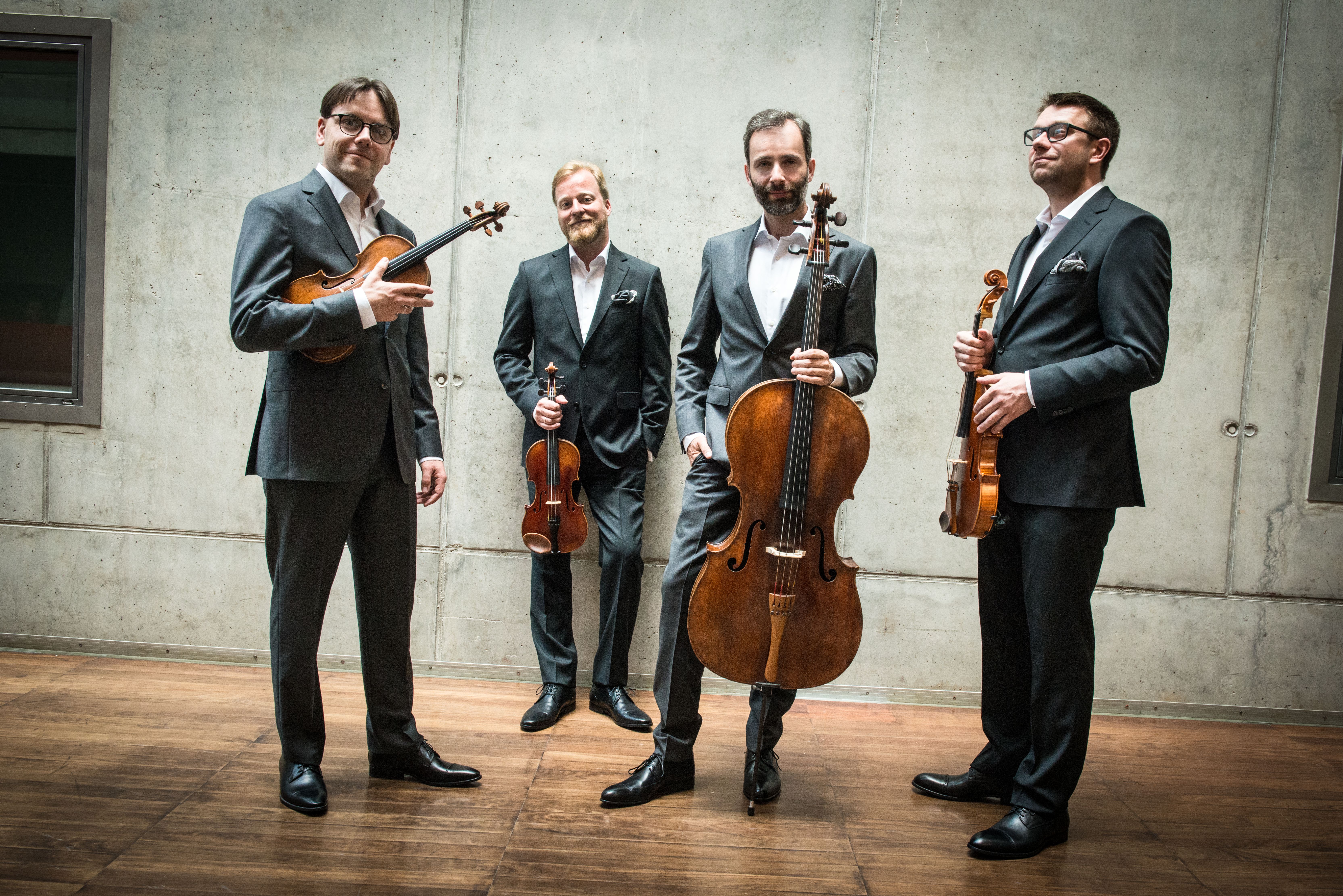
Zemlinsky Quartet program notes
Some of the most powerful string quartets say as much between the notes as within them. Tonight's program brings together three works separated by more than a century, yet joined by a common thread: each conceals a story the composer never fully spelled out on the page. A secret literary program, a folk tradition silenced by war, an illness that reshaped the very grammar of a composer's late style — in each case, the biography lives beneath the surface, audible only to those who listen for it.
Ludwig van Beethoven
String Quartet in F major, Op. 18, No. 1 (1798–1800)
Beethoven was around twenty-eight years old, recently settled in Vienna, and freshly schooled in counterpoint by Johann Georg Albrechtsberger when he turned, for the first time, to the string quartet — a genre that Haydn had invented and Mozart had perfected. It was a daunting inheritance. Beethoven spent nearly two years absorbed in the task, filling sketchbooks with revisions before producing the set of six quartets published in 1801 as his Op. 18. Although this F major quartet was actually the second of the six to be composed, Beethoven placed it first in the published order — a deliberate opening statement, full of energy and craft, from a young composer determined to prove he belonged in such company.
The confession hidden inside this quartet concerns its slow movement. Beethoven sent an early draft to his close friend Karl Amenda with the score annotated in French: il se rend au tombeau (he goes to the tomb), le désespoir (despair), il se tue (he kills himself) — a private key mapping the music onto the tomb scene from Shakespeare's Romeo and Juliet. Years later, when Amenda recalled that the Adagio had suggested to him "the parting of two lovers," Beethoven confirmed it outright: he had indeed been thinking of the burial vault scene. None of this appears in the published score. By the time Op. 18 went to print, Beethoven had reworked the quartet so extensively that he asked Amenda to discard his earlier copy, writing that “only now have I learned how to write quartets.” The literary program disappeared from the page, but the music retains its emotional shape: an Adagio affettuoso ed appassionato that moves from elegiac tenderness to sudden, stabbing shock, gaping silences, and a final, resigned sigh.
The outer movements return to daylight. The opening Allegro con brio spins an entire movement from a fleet six-note motif, tiling the music like a repeating wallpaper pattern — a hallmark of the Viennese classical style Beethoven inherited from Haydn and Mozart alike. A driving Scherzo and a contrapuntally rich finale, complete with two passages of fugato, close the work with the wit and technical bravado of a composer eager to announce himself.
Béla Bartók
String Quartet No. 2, Op. 17, Sz. 67 (1915–1917)
Before the First World War, Bartók’s musical identity had been built as much in the field as at the writing desk. Alongside Zoltán Kodály, he had spent years travelling through rural Hungary, Romania, and North Africa, transcribing folk melodies that would permanently reshape his harmonic and rhythmic language. The war closed the borders and ended the fieldwork almost overnight. Composed between 1915 and October 1917 in the village of Rákoskeresztúr, the Second Quartet was written in that enforced isolation — “the muses are not silent even during a modern war,” Bartók wrote to a friend at the time, with a certain grim irony. He dedicated it to the Waldbauer-Kerpely Quartet, the same ensemble that premiered his First Quartet in 1910 and remained, for many years, virtually the only Hungarian group willing to perform his music. They gave the Second Quartet its premiere in Budapest on March 3, 1918.
Cut off from the villages where he once gathered material firsthand, Bartók turned the folk idiom inward, absorbing it so completely into his own harmonic thinking that it surfaces less as quotation than as native vocabulary. The quartet unfolds in three movements rather than the traditional four: an inward-looking Moderato; a fierce, dance-driven Allegro molto capriccioso built from jagged rhythms and folk-inflected asymmetry; and a Lento finale that drifts between desolation and impassioned outcry. Kodály, hearing an autobiography in the shape of the piece, described its three movements as depicting a peaceful life, its disruption by violent forces, and grief. Nothing in the score names the war directly, but the quartet's arc — from settled interiority through brutal upheaval to lament — tracks the years of its composition closely enough that the history feels inseparable from the music, even in its absence from the page.
Bedřich Smetana
String Quartet No. 2 in D minor (1882–1883)
By the time Smetana began his Second Quartet, he had been completely deaf for nearly a decade — a condition now generally attributed to neurosyphilis, though his contemporaries and doctors were unable to say with certainty. The deafness had already ended his career as a conductor and forced him out of Prague’s musical life. He composed this quartet, his last completed work, explicitly against his doctors' orders that he abstain from music altogether, while in the grip of the physical and mental deterioration that would kill him within two years.
His First Quartet, subtitled “From My Life,” had come with an explicit program: Smetana himself explained how its finale depicted the onset of his deafness, rendered as a piercing high harmonic that interrupts the music like a physical event. The Second Quartet offers no such key. Smetana left only a handful of remarks about it, and they describe not meaning but difficulty: writing to a friend about the first movement, he confessed, “I have my doubts with regard to the form of this movement. It has a very unusual form and is difficult to understand. A kind of breakdown prevails throughout the movement... This is a result of my unhappy life.” The quartet is compressed, harmonically restless, and structurally fragmented in ways that unsettled even Smetana's admirers, some of whom long mistook its density and discontinuity for an incomplete creative process rather than a deliberate style.
Yet the piece is not without light. Tucked into the second movement is a polka Smetana had written decades earlier, in his mid-twenties — a memory of an entirely different life resurfacing, uninvited, in the middle of his most turbulent score. The quartet's four movements (Allegro; Allegro moderato; Allegro non più moderato, ma agitato e con fuoco; and a Presto finale) trace a work so concentrated and emotionally intense that it is often credited with anticipating the string quartets Leoš Janáček would write decades later. Nothing here narrates deafness or illness the way the First Quartet did. Instead, the music seems to enact its composer’s condition directly — contemporaries described it as sounding like “a swirl of music of a person who has lost his hearing,” not a description of the illness, but one of its symptoms, audible in the very fabric of the piece.
Taken together, these three quartets trace a single idea from three very different angles: a hidden text, a silenced tradition, and an unspoken illness, each shaping the music from behind the scenes rather than announcing itself on the surface. Tonight’s invitation is simply to listen past the notes to what lies between them.
Ludwig van Beethoven
String Quartet in F major, Op. 18, No. 1 (1798–1800)
Beethoven was around twenty-eight years old, recently settled in Vienna, and freshly schooled in counterpoint by Johann Georg Albrechtsberger when he turned, for the first time, to the string quartet — a genre that Haydn had invented and Mozart had perfected. It was a daunting inheritance. Beethoven spent nearly two years absorbed in the task, filling sketchbooks with revisions before producing the set of six quartets published in 1801 as his Op. 18. Although this F major quartet was actually the second of the six to be composed, Beethoven placed it first in the published order — a deliberate opening statement, full of energy and craft, from a young composer determined to prove he belonged in such company.
The confession hidden inside this quartet concerns its slow movement. Beethoven sent an early draft to his close friend Karl Amenda with the score annotated in French: il se rend au tombeau (he goes to the tomb), le désespoir (despair), il se tue (he kills himself) — a private key mapping the music onto the tomb scene from Shakespeare's Romeo and Juliet. Years later, when Amenda recalled that the Adagio had suggested to him "the parting of two lovers," Beethoven confirmed it outright: he had indeed been thinking of the burial vault scene. None of this appears in the published score. By the time Op. 18 went to print, Beethoven had reworked the quartet so extensively that he asked Amenda to discard his earlier copy, writing that “only now have I learned how to write quartets.” The literary program disappeared from the page, but the music retains its emotional shape: an Adagio affettuoso ed appassionato that moves from elegiac tenderness to sudden, stabbing shock, gaping silences, and a final, resigned sigh.
The outer movements return to daylight. The opening Allegro con brio spins an entire movement from a fleet six-note motif, tiling the music like a repeating wallpaper pattern — a hallmark of the Viennese classical style Beethoven inherited from Haydn and Mozart alike. A driving Scherzo and a contrapuntally rich finale, complete with two passages of fugato, close the work with the wit and technical bravado of a composer eager to announce himself.
Béla Bartók
String Quartet No. 2, Op. 17, Sz. 67 (1915–1917)
Before the First World War, Bartók’s musical identity had been built as much in the field as at the writing desk. Alongside Zoltán Kodály, he had spent years travelling through rural Hungary, Romania, and North Africa, transcribing folk melodies that would permanently reshape his harmonic and rhythmic language. The war closed the borders and ended the fieldwork almost overnight. Composed between 1915 and October 1917 in the village of Rákoskeresztúr, the Second Quartet was written in that enforced isolation — “the muses are not silent even during a modern war,” Bartók wrote to a friend at the time, with a certain grim irony. He dedicated it to the Waldbauer-Kerpely Quartet, the same ensemble that premiered his First Quartet in 1910 and remained, for many years, virtually the only Hungarian group willing to perform his music. They gave the Second Quartet its premiere in Budapest on March 3, 1918.
Cut off from the villages where he once gathered material firsthand, Bartók turned the folk idiom inward, absorbing it so completely into his own harmonic thinking that it surfaces less as quotation than as native vocabulary. The quartet unfolds in three movements rather than the traditional four: an inward-looking Moderato; a fierce, dance-driven Allegro molto capriccioso built from jagged rhythms and folk-inflected asymmetry; and a Lento finale that drifts between desolation and impassioned outcry. Kodály, hearing an autobiography in the shape of the piece, described its three movements as depicting a peaceful life, its disruption by violent forces, and grief. Nothing in the score names the war directly, but the quartet's arc — from settled interiority through brutal upheaval to lament — tracks the years of its composition closely enough that the history feels inseparable from the music, even in its absence from the page.
Bedřich Smetana
String Quartet No. 2 in D minor (1882–1883)
By the time Smetana began his Second Quartet, he had been completely deaf for nearly a decade — a condition now generally attributed to neurosyphilis, though his contemporaries and doctors were unable to say with certainty. The deafness had already ended his career as a conductor and forced him out of Prague’s musical life. He composed this quartet, his last completed work, explicitly against his doctors' orders that he abstain from music altogether, while in the grip of the physical and mental deterioration that would kill him within two years.
His First Quartet, subtitled “From My Life,” had come with an explicit program: Smetana himself explained how its finale depicted the onset of his deafness, rendered as a piercing high harmonic that interrupts the music like a physical event. The Second Quartet offers no such key. Smetana left only a handful of remarks about it, and they describe not meaning but difficulty: writing to a friend about the first movement, he confessed, “I have my doubts with regard to the form of this movement. It has a very unusual form and is difficult to understand. A kind of breakdown prevails throughout the movement... This is a result of my unhappy life.” The quartet is compressed, harmonically restless, and structurally fragmented in ways that unsettled even Smetana's admirers, some of whom long mistook its density and discontinuity for an incomplete creative process rather than a deliberate style.
Yet the piece is not without light. Tucked into the second movement is a polka Smetana had written decades earlier, in his mid-twenties — a memory of an entirely different life resurfacing, uninvited, in the middle of his most turbulent score. The quartet's four movements (Allegro; Allegro moderato; Allegro non più moderato, ma agitato e con fuoco; and a Presto finale) trace a work so concentrated and emotionally intense that it is often credited with anticipating the string quartets Leoš Janáček would write decades later. Nothing here narrates deafness or illness the way the First Quartet did. Instead, the music seems to enact its composer’s condition directly — contemporaries described it as sounding like “a swirl of music of a person who has lost his hearing,” not a description of the illness, but one of its symptoms, audible in the very fabric of the piece.
Taken together, these three quartets trace a single idea from three very different angles: a hidden text, a silenced tradition, and an unspoken illness, each shaping the music from behind the scenes rather than announcing itself on the surface. Tonight’s invitation is simply to listen past the notes to what lies between them.