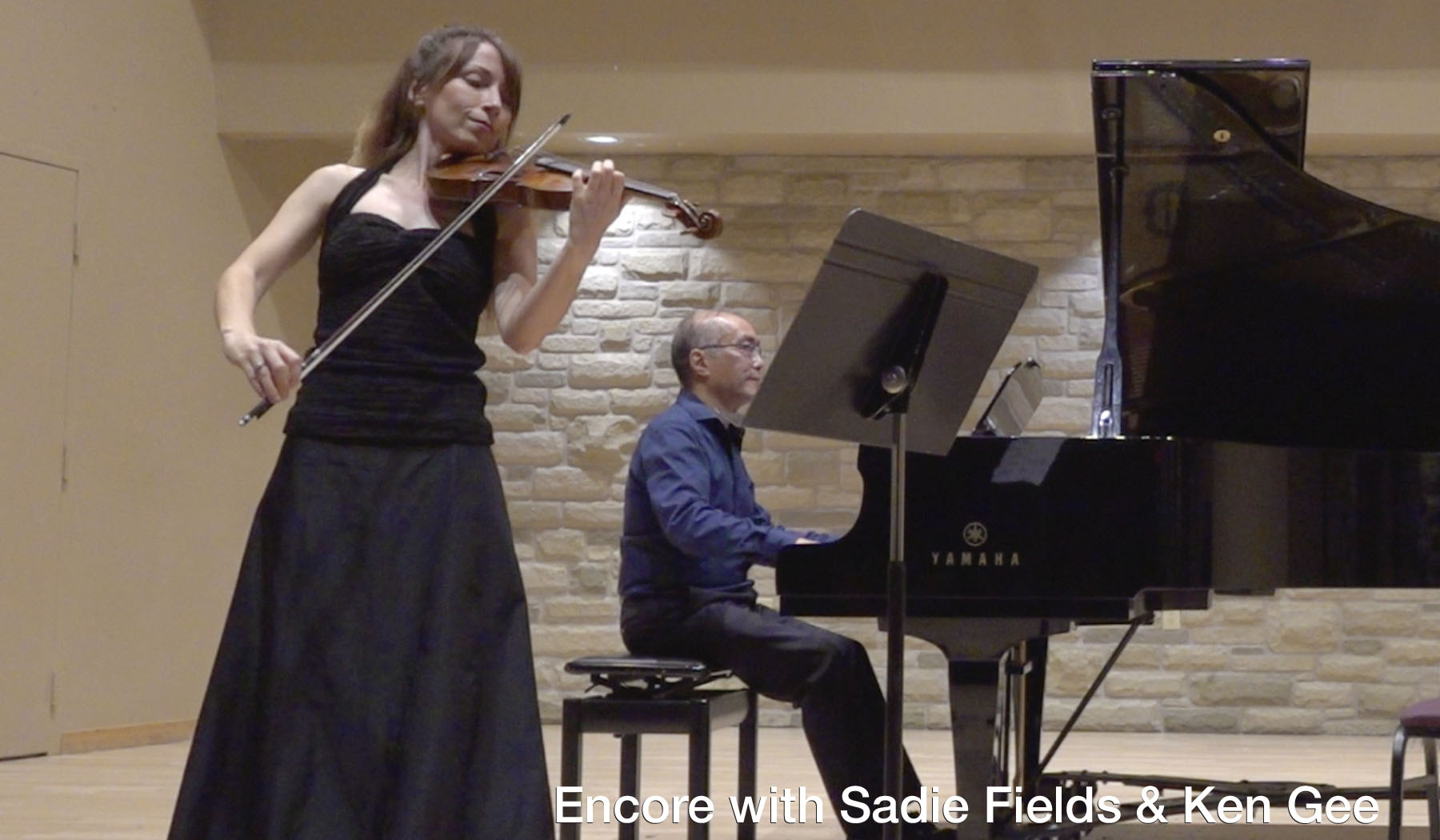
Reimagination program notes
Music’s relationship with the past is rarely a simple matter of preservation. Composers borrow dances, transform folk songs, revisit earlier styles and translate poetry into sound. Performers, too, reshape what they inherit: an arrangement can bring an old work into a new concert hall, while a persuasive interpretation can make something familiar seem newly discovered.
In 1935, the violinist Fritz Kreisler acknowledged that several supposedly rediscovered works by earlier composers were actually his own creations. The revelation raised an awkward question: if audiences had loved the music under someone else’s name, should knowing its true authorship change their response? His Three Old Viennese Dances have a related history: they initially appeared under the name of the nineteenth-century dance composer Joseph Lanner. Their Vienna was already, in part, an act of imagination.
That creative exchange between inheritance and invention runs through this recital. An attributed Baroque chaconne reaches us through a Romantic violinist’s arrangement; a twentieth-century composer fashions an imaginary old-world suite; poetry becomes birdsong; and Spanish songs acquire a new voice on the violin. These are not simply journeys into the past. They reveal what later musicians hear there—and what they bring back.
Attributed to Tomaso Antonio Vitali (1663–1745)
Arranged by Ferdinand David (1810–1873)
Chaconne in G minor
The Chaconne’s musical authority is more secure than its authorship. An eighteenth-century Dresden manuscript bears an inscription conventionally understood to identify Tomaso Antonio Vitali, but the attribution remains uncertain. Its modern fame owes much to Ferdinand David, whose 1867 edition recast the piano accompaniment and brought the work into the Romantic violin repertoire.
A chaconne builds successive variations upon recurring harmonic foundations. Here, the violin transforms that framework through sustained melody, elaborate passagework and powerful chordal writing. Unexpected journeys into distant keys intensify the drama—and have raised questions about attribution. The work opens the recital with a compelling paradox: music rooted in repetition that continually discovers something new.
Schnittke’s Old Style, Filtered Through Soviet Cinema
Alfred Schnittke: Suite in the Old Style
For Alfred Schnittke, earlier musical styles were not museum exhibits. They were living materials, available for affection, quotation, distortion and dialogue. His broader practice of bringing different historical idioms into contact is often described as “polystylism.” The Suite in the Old Style, assembled in 1972 for violin and piano or harpsichord, presents a particularly approachable encounter with that musical past.
The suite draws on Schnittke’s film music, including material from The Adventures of a Dentist. This theatrical background helps explain its succession of sharply defined characters. Rather than reconstructing one particular eighteenth-century model, Schnittke evokes a remembered world of pastoral melodies, courtly dances and contrapuntal ingenuity. The result is a historical style viewed through a modern imagination.
The Pastorale opens a gently ordered landscape, its melodic simplicity suggesting a world momentarily free of complication. Balletto introduces a more animated, buoyant elegance, while the Minuetto turns towards the poise of a formal dance. In Fuga, the violin and keyboard pursue one another through imitative exchanges, giving the suite a livelier contrapuntal energy. Pantomima brings a more ambiguous conclusion: the graceful surface becomes unsettled, and the distance between Schnittke and his imagined past grows harder to ignore.
The pleasure lies partly in how convincing this “old style” can be—and partly in the moments when it ceases to behave quite as expected. Schnittke’s historical imagination accommodates tenderness as well as irony. The suite need not be heard as a joke at the expense of earlier music; its beauty also suggests the attraction of a musical world that can be recalled but never fully recovered.
Fritz Kreisler (1875–1962)
Three Old Viennese Dances
Few violinists have left so distinctive a personal signature on the repertoire as Fritz Kreisler. His short works combine melodic generosity with an intimate knowledge of the instrument, and the Three Old Viennese Dances are among the most enduring examples. Published in a 1905 collection as Alt-Wiener Tanzweisen, they initially appeared under the name of Joseph Lanner, an important figure in the development of the Viennese waltz. Their historical disguise thus differs from that of Kreisler’s pseudo-Baroque miniatures: here he imagined the Vienna of an earlier nineteenth century.
These pieces are portraits rather than documentary reconstructions. They evoke a city remembered through its dances: elegant, sociable, sentimental and alert to the proximity of pleasure and regret. Their apparent spontaneity conceals a finely judged balance between melody, gesture and rhythmic lift.
Liebesfreud announces itself with expansive confidence. Its title promises love’s joy, and its bright gestures turn that promise into public celebration. Liebesleid answers in a more inward voice: the dance continues, but its movement now carries wistfulness rather than exuberance. Their juxtaposition makes joy and sorrow feel less like opposites than neighbouring states of mind. Schön Rosmarin, the briefest of the three, restores a lighter, more playful character, its quicksilver charm ending the group without attempting to resolve its emotional contrasts.
Placed after Schnittke, the dances offer another form of historical make-believe. Where Schnittke allows the seams of his reconstruction to show, Kreisler makes the imagined past feel effortlessly inhabited. The first half ends not with the recovery of an untouched tradition, but with a performer-composer’s affectionate reinvention of one.
Tartini and the Grief of Dido
Giuseppe Tartini: Violin Sonata in G minor, Op. 1, No. 10 (“Didone abbandonata”)
Tartini’s G minor Sonata belongs to the collection of twelve sonatas published as his Op. 1 in Amsterdam in 1734. Its familiar subtitle, Didone abbandonata, links it with Dido, the Queen of Carthage abandoned by Aeneas. The title is a later addition rather than a securely established statement of Tartini’s intention: it gives the music a dramatic identity that listeners have found compelling, without making the sonata a literal narrative of Dido’s fate.
That distinction matters. A title can transform the way music is heard even when no notes change. Once Dido’s name is attached to this sonata, a sustained phrase may suggest pleading, an agitated passage anger, a moment of repose remembered tenderness. Yet the music also speaks persuasively without a specific story. Its expressive language belongs to Tartini’s mastery of the violin as a singing instrument.
The opening indication, Affettuoso, invites an affectionate, feelingful manner. Rather than rushing towards virtuoso display, the violin unfolds its phrases with the flexibility of a voice. Ornamentation becomes part of that speech: it can intensify a gesture, delay a resolution or give a repeated idea a new emotional weight. The two faster movements bring contrast within the same G minor tonal world, moving from the urgency of the Presto to the more dance-like animation of the concluding Allegro.
In this recital, Tartini offers a different kind of reimagination. The transformation occurs not chiefly through arrangement or imitation, but through reception: later generations supplied a literary frame, and that frame became part of the work’s identity. The sonata reminds us that a composition’s history includes not only its creation, but the stories listeners later hear within it.
An English Folksong, Given Wings
Ralph Vaughan Williams: The Lark Ascending
Although now most familiar in its orchestral form, The Lark Ascending began as music for violin and piano. Vaughan Williams composed it in 1914 and returned to it after the First World War. Its first public performance took place on 15 December 1920 at Shirehampton, near Bristol, with the dedicatee Marie Hall as violinist and Geoffrey Mendham at the piano. Hall also gave the orchestral premiere the following year. In a violin-and-piano recital, the work therefore returns to the medium in which audiences first encountered it.
Its starting point was George Meredith’s poem The Lark Ascending, published in 1881. Vaughan Williams prefaced his score with selected lines from the poem, whose image of a skylark’s rising song becomes a meditation on expression, freedom and the relationship between the human and natural worlds. The composition does not trace every detail of Meredith’s text. It responds instead to the poem’s central imaginative act: following a song as it seems to rise beyond ordinary reach.
The violin’s opening, cadenza-like phrases seem to discover their own direction. Their flexible rhythm and circling contours suggest flight without reducing the music to a literal transcription of birdsong. When the accompaniment enters more fully, it supplies a gentle landscape beneath the soloist. More animated, folk-like episodes bring a sense of human movement into that landscape before the violin returns to its freer, more solitary utterance.
The piano version gives these relationships a particular intimacy. Its lighter texture allows the violin’s line to feel suspended in open space, while the final ascent gradually withdraws from the measured world of accompaniment. Here, reimagination is neither disguise nor reconstruction. It is the passage from one art to another: a poem’s image becomes a musical experience.
Two Spanish Songbooks, Refashioned for Violin
Manuel de Falla: Suite populaire espagnole
The recital closes with music that has travelled through several forms of expression. Falla’s Siete canciones populares españolas, composed in 1914–15 for voice and piano, draws on the songs and musical idioms of different Spanish regions. In 1925, the violinist Paul Kochański adapted six of the seven songs for violin and piano, omitting the Seguidilla murciana and changing the sequence. The resulting Suite populaire espagnole is not merely the vocal cycle transferred intact to an instrument; its new order creates a distinct instrumental journey.
The loss of words might seem a substantial sacrifice in music originally conceived as song. Yet the violin offers other expressive resources: sustained tone, changes of register, articulation and the subtle shaping of a phrase. Falla’s piano writing remains an essential partner, preserving the rhythmic character and harmonic colour that make these miniatures much more than simple presentations of folk melodies.
El paño moruno opens with rhythmic bite and a compact dramatic energy. Nana turns immediately towards intimacy, its lullaby character drawing attention to the quiet intensity of the melodic line. Canción offers a briefer, more direct utterance before Polo breaks into a fiercer emotional register. The succession makes the violin alternately storyteller, singer and dancer.
Asturiana, placed near the end in Kochański’s sequence, brings the suite’s most sustained moment of stillness: a restrained lament whose simplicity concentrates rather than diminishes its feeling. The concluding Jota releases that restraint into the rhythmic vitality of dance. Ending here gives the entire recital an outward-looking conclusion, carrying the listener from reflective song into shared movement.
Across the evening, the past has appeared as manuscript, memory, dramatic story, poetic image and folk tradition. Falla and Kochański bring those possibilities together in miniature: inherited music remains recognizably itself, yet changes when another musician gives it a new voice.