Penderecki Quartet program notes
The Penderecki String Quartet celebrates its 40th anniversary with a program spanning classical mastery, modern introspection, and Bohemian lyricism. Presented by Guelph Musicfest at the Guelph Youth Music Centre Recital Hall, this concert features the ensemble's signature blend of tradition and innovation.
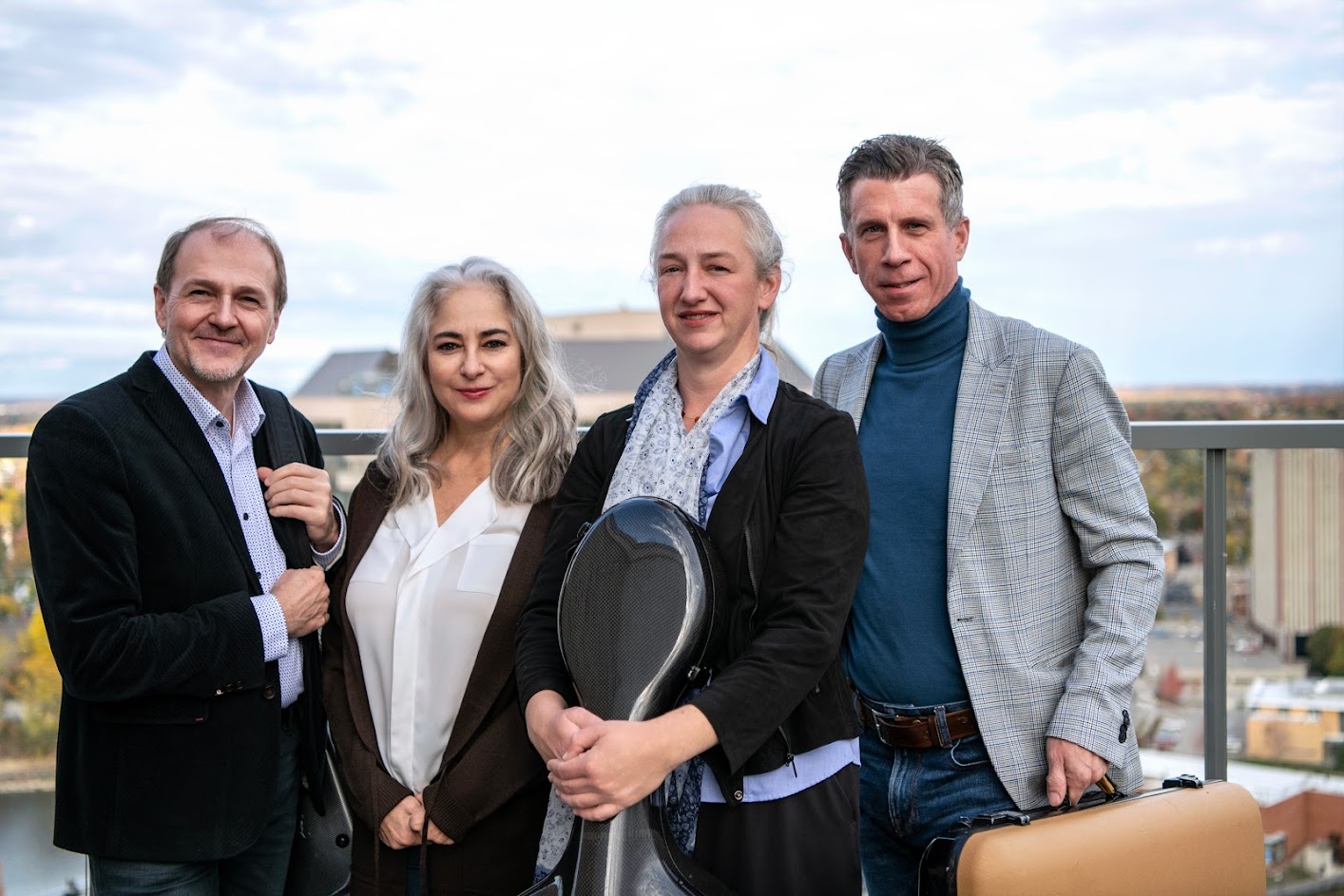
Penderecki Quartet
Founded in 1986 as winners of the Penderecki Prize at Poland's National Chamber Music Competition in Łódz, the Penderecki String Quartet has evolved into one of Canada's most acclaimed ensembles. Based in Waterloo, Ontario, as Quartet-in-Residence at Wilfrid Laurier University since 1991, its members—originating from Poland, Canada, and the USA—deliver performances noted for "remarkable range of technical excellence and emotional sweep."
The quartet has premiered over 100 new works, recorded extensively (including Beethoven, Brahms, and Bartók cycles, plus a JUNO-winning disc), and collaborated with artists from jazz saxophonists to turntablists. They worked directly with Krzysztof Penderecki on his Third Quartet for his 80th birthday in 2013 and recorded it soon after. For this 40th anniversary milestone, expect their honed precision in a Guelph homecoming.
Beethoven Quartet Op. 59, No. 2
Composed in 1805-06 for Russian ambassador Count Andreas Razumovsky, Beethoven's String Quartet No. 8 in E minor launches his "Middle Quartets" with bold innovation, diverging from Haydn-Mozart norms through expansive forms and emotional depth.
I. Allegro
Two stark chords halt abruptly, birthing a terse, nervous theme in hushed arpeggios—echoing the Eroica Symphony but laced with tension. Semitonal clashes and Neapolitan harmony propel development; unusually, Beethoven repeats exposition, development, and recapitulation, amplifying circling momentum.
II. Molto adagio
Inspired by starry skies and "music of the spheres" (per pupil Czerny), this sonata-form hymn glides in major-key serenity, a noble cortege bearing grief with long, smooth lines. Subdued yet substantial, it contrasts the first movement's volatility, evoking Op. 132's Heiliger Dankgesang.
III. Allegretto
A brash scherzo-trio fuses fugue and variation on a Russian folk theme (later in Mussorgsky's Boris Godunov), its ABABA structure glittering with harmonic clashes—tonic over dominant for comic bite. Beethoven reportedly "pile-drove" the tune handed by Razumovsky.
IV. Presto
Boisterous and good-humored, the finale erupts in C major (a tonic shock), channeling wild energy to an exuberant close.
Penderecki Quartet No. 3
Krzysztof Penderecki's 2008 String Quartet No. 3 ("Leaves of an Unwritten Diary"), commissioned by the Shanghai String Quartet, marks his late neo-Romantic turn—diatonic, retrospective, blending sonorism with halting waltzes, heterophony, and childhood gypsy tunes.
Opening in E-flat minor with viola melody over a triad, it evokes personal preoccupations via grotesque minor-third waltzes and restless tempo shifts, sans numbered movements but with duality (e.g., B/B-flat minor centers). Textures wander placidly, erupt in rhythmic climaxes, and dissolve in glissandi—reflective, non-sentimental diary scraps.
The PSQ's close ties to Penderecki infuse their rendition with authority, bridging his avant-garde quartets (1960, 1968) to this plangent, passionate world.
Dvořák Piano Quintet Op. 81
Revised in 1887 from an 1872 predecessor, Antonín Dvořák's Piano Quintet No. 2 in A major exemplifies his golden maturity—lyrical, rhythmic mastery fusing Czech folk vitality with Classical poise, premiered in Prague in 1888.
I. Allegro ma non tanto
Cello intones a noble theme over piano arpeggios; the viola’s busier second subject in C major sparks colourful variations in sonata form, rushing to an exuberant coda.
II. Dumka: Andante con moto
A wistful F-sharp minor piano theme (dumka: Slavic lament-dance) unfolds transparently; D-major interlude yields frenzied repeats, blending melancholy and ecstasy in rondo-like A-B-A-C-A-B-A.
III. Scherzo: Molto vivace
Furiant rhythms drive this playful dance, trio tinkering ingeniously with pulse for boisterous contrast.
IV. Finale: Allegro
Syncopated piano bursts into raucous strings and fugal theme; a tranquillo chorale coda introspects before hurtling to triumph (~40 minutes total).
With guest pianist Ken Gee, the Penderecki Quartet illuminates Dvořák's rhythmic genius alongside Beethoven's drama and Penderecki's introspection.
Penderecki Quartet
Founded in 1986 as winners of the Penderecki Prize at Poland's National Chamber Music Competition in Łódz, the Penderecki String Quartet has evolved into one of Canada's most acclaimed ensembles. Based in Waterloo, Ontario, as Quartet-in-Residence at Wilfrid Laurier University since 1991, its members—originating from Poland, Canada, and the USA—deliver performances noted for "remarkable range of technical excellence and emotional sweep."
The quartet has premiered over 100 new works, recorded extensively (including Beethoven, Brahms, and Bartók cycles, plus a JUNO-winning disc), and collaborated with artists from jazz saxophonists to turntablists. They worked directly with Krzysztof Penderecki on his Third Quartet for his 80th birthday in 2013 and recorded it soon after. For this 40th anniversary milestone, expect their honed precision in a Guelph homecoming.
Beethoven Quartet Op. 59, No. 2
Composed in 1805-06 for Russian ambassador Count Andreas Razumovsky, Beethoven's String Quartet No. 8 in E minor launches his "Middle Quartets" with bold innovation, diverging from Haydn-Mozart norms through expansive forms and emotional depth.
I. Allegro
Two stark chords halt abruptly, birthing a terse, nervous theme in hushed arpeggios—echoing the Eroica Symphony but laced with tension. Semitonal clashes and Neapolitan harmony propel development; unusually, Beethoven repeats exposition, development, and recapitulation, amplifying circling momentum.
II. Molto adagio
Inspired by starry skies and "music of the spheres" (per pupil Czerny), this sonata-form hymn glides in major-key serenity, a noble cortege bearing grief with long, smooth lines. Subdued yet substantial, it contrasts the first movement's volatility, evoking Op. 132's Heiliger Dankgesang.
III. Allegretto
A brash scherzo-trio fuses fugue and variation on a Russian folk theme (later in Mussorgsky's Boris Godunov), its ABABA structure glittering with harmonic clashes—tonic over dominant for comic bite. Beethoven reportedly "pile-drove" the tune handed by Razumovsky.
IV. Presto
Boisterous and good-humored, the finale erupts in C major (a tonic shock), channeling wild energy to an exuberant close.
Penderecki Quartet No. 3
Krzysztof Penderecki's 2008 String Quartet No. 3 ("Leaves of an Unwritten Diary"), commissioned by the Shanghai String Quartet, marks his late neo-Romantic turn—diatonic, retrospective, blending sonorism with halting waltzes, heterophony, and childhood gypsy tunes.
Opening in E-flat minor with viola melody over a triad, it evokes personal preoccupations via grotesque minor-third waltzes and restless tempo shifts, sans numbered movements but with duality (e.g., B/B-flat minor centers). Textures wander placidly, erupt in rhythmic climaxes, and dissolve in glissandi—reflective, non-sentimental diary scraps.
The PSQ's close ties to Penderecki infuse their rendition with authority, bridging his avant-garde quartets (1960, 1968) to this plangent, passionate world.
Dvořák Piano Quintet Op. 81
Revised in 1887 from an 1872 predecessor, Antonín Dvořák's Piano Quintet No. 2 in A major exemplifies his golden maturity—lyrical, rhythmic mastery fusing Czech folk vitality with Classical poise, premiered in Prague in 1888.
I. Allegro ma non tanto
Cello intones a noble theme over piano arpeggios; the viola’s busier second subject in C major sparks colourful variations in sonata form, rushing to an exuberant coda.
II. Dumka: Andante con moto
A wistful F-sharp minor piano theme (dumka: Slavic lament-dance) unfolds transparently; D-major interlude yields frenzied repeats, blending melancholy and ecstasy in rondo-like A-B-A-C-A-B-A.
III. Scherzo: Molto vivace
Furiant rhythms drive this playful dance, trio tinkering ingeniously with pulse for boisterous contrast.
IV. Finale: Allegro
Syncopated piano bursts into raucous strings and fugal theme; a tranquillo chorale coda introspects before hurtling to triumph (~40 minutes total).
With guest pianist Ken Gee, the Penderecki Quartet illuminates Dvořák's rhythmic genius alongside Beethoven's drama and Penderecki's introspection.