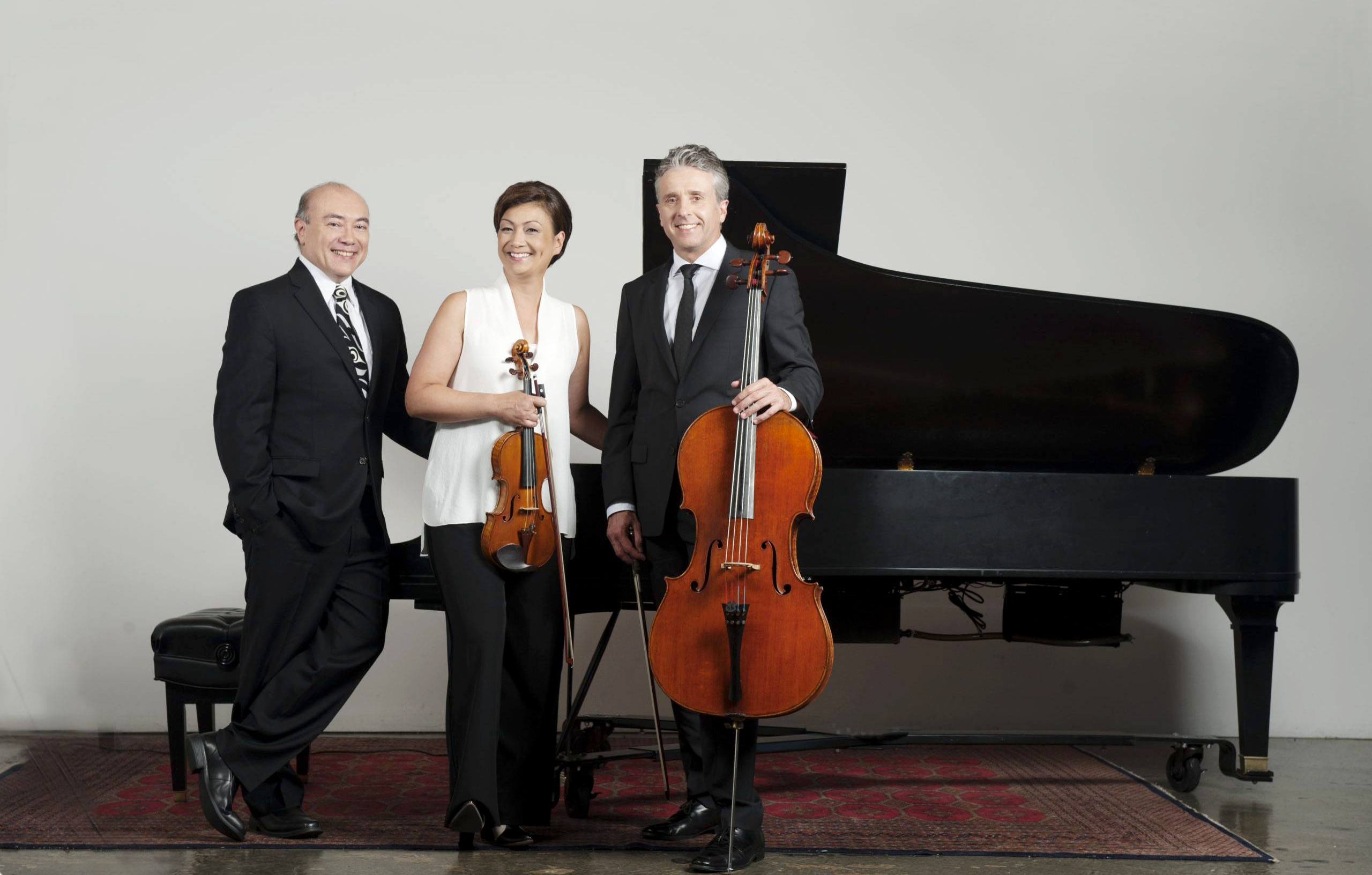
Gryphon Trio program notes
For over three decades, the Gryphon Trio has stood at the forefront of chamber music in Canada and around the world, acclaimed for their deep musical insight, imaginative programming, and dedication to expanding the piano trio repertoire. This program traces the piano trio’s development from its Classical origins in Mozart’s 18th century to 21st‑century innovations by Sri Lankan‑Canadian composer Dinuk Wijeratne—whose Love Triangle was written specifically for the ensemble. Together, these works reveal how the trio’s intimate conversation among piano, violin, and cello has remained a powerful space for human expression across time and culture.
Wolfgang Amadeus Mozart (1756–1791)
Divertimento in B‑flat major, K. 254 – I. Allegro assai
Composed in 1776 when Mozart was just twenty, this Divertimento marks one of his first forays into the piano trio form. At the time, such works were often intended for private entertainment, yet Mozart brings striking sophistication and balance to the genre. The Allegro assai brims with youthful charm—its lively interplay between instruments hinting at the conversational equality that would define the mature trio form. Beneath its polished surface, one senses Mozart’s curiosity and inventiveness in shaping a new kind of musical partnership among three voices.
Ludwig van Beethoven (1770–1827)
Piano Trio in E‑flat major, Op. 1 No. 1 – I. Allegro
Beethoven’s Op. 1 trios announced his arrival in Vienna as a formidable new voice. The E‑flat major Trio’s opening movement radiates confidence, combining Classical clarity with bold dynamic contrasts and rhythmic drive. Beethoven transforms the trio from salon entertainment into a larger, symphonic statement—each instrument asserting individuality while contributing to a coherent, dramatic whole. The Allegro’s brilliance and intensity reveal a young composer redefining the possibilities of chamber music.
Franz Schubert (1797–1828)
Piano Trio in B‑flat major, D. 898 (Op. 99) – II. Andante un poco mosso
Written in 1827, Schubert’s B‑flat Trio glows with melodic warmth and emotional depth. The Andante un poco mosso provides an oasis of serenity: a graceful piano line supports the violin’s lyrical singing and the cello’s tender replies. Schubert’s uncanny gift for song permeates the movement, which drifts gently between major and minor, joy and reflection. Its unhurried beauty captures the Romantic spirit at its most intimate—music that seems to breathe, dream, and sigh like a human voice.
Rebecca Clarke (1886–1979)
Piano Trio – I. Moderato ma appassionato
Rebecca Clarke’s 1921 Piano Trio reveals a composer of exceptional emotional range and coloristic imagination. The first movement, Moderato ma appassionato, balances rhapsodic passion with refined craftsmanship. Clarke’s harmonic language—imbued with Impressionist hues and late‑Romantic depth—creates a richly textured dialogue where all three instruments share equal footing. The result is music at once turbulent and tender, expressive of both personal introspection and the shifting world of post‑War modernism. Long overlooked, Clarke’s chamber works today stand among the finest of her generation.
Dinuk Wijeratne (b. 1978)
Love Triangle (2013)
Commissioned by and written for the Gryphon Trio, Love Triangle embodies Wijeratne’s cross‑cultural voice—a seamless fusion of Western classical structure, jazz improvisation, and South Asian rhythmic vitality. The work’s title plays on the trio’s three‑way relationship: a musical and emotional triangle of contrast and unity. Propelled by kinetic energy, glittering piano passages, and intricate interplay between strings and keyboard, the music celebrates the joy of collaboration itself. For Wijeratne, the love triangle is not conflict but creative chemistry—an exploration of how difference generates harmony.
Antonín Dvořák (1841–1904)
Piano Trio No. 3 in F minor, Op. 65 (B.130)
Composed in 1883 following his mother’s death, Dvořák’s F minor Trio channels grief and passion into noble musical architecture. The first movement opens with an urgent, tragic motif that alternates with expansively lyrical themes, reflecting conflict between sorrow and consolation. Romantic intensity merges with Dvořák’s distinctly Czech rhythmic character, lending vitality to even the most somber passages. The work’s sweeping emotional journey concludes this program with a sense of catharsis—an affirmation of life’s expressive power through the collective voice of the trio.
This program invites listeners to travel through more than two centuries of musical evolution, guided by the exceptional artistry of the Gryphon Trio. From Mozart’s poised beginnings to Wijeratne’s rhythmic modernity, the trio remains a living conversation—three instruments, one shared language of imagination and feeling.
Wolfgang Amadeus Mozart (1756–1791)
Divertimento in B‑flat major, K. 254 – I. Allegro assai
Composed in 1776 when Mozart was just twenty, this Divertimento marks one of his first forays into the piano trio form. At the time, such works were often intended for private entertainment, yet Mozart brings striking sophistication and balance to the genre. The Allegro assai brims with youthful charm—its lively interplay between instruments hinting at the conversational equality that would define the mature trio form. Beneath its polished surface, one senses Mozart’s curiosity and inventiveness in shaping a new kind of musical partnership among three voices.
Ludwig van Beethoven (1770–1827)
Piano Trio in E‑flat major, Op. 1 No. 1 – I. Allegro
Beethoven’s Op. 1 trios announced his arrival in Vienna as a formidable new voice. The E‑flat major Trio’s opening movement radiates confidence, combining Classical clarity with bold dynamic contrasts and rhythmic drive. Beethoven transforms the trio from salon entertainment into a larger, symphonic statement—each instrument asserting individuality while contributing to a coherent, dramatic whole. The Allegro’s brilliance and intensity reveal a young composer redefining the possibilities of chamber music.
Franz Schubert (1797–1828)
Piano Trio in B‑flat major, D. 898 (Op. 99) – II. Andante un poco mosso
Written in 1827, Schubert’s B‑flat Trio glows with melodic warmth and emotional depth. The Andante un poco mosso provides an oasis of serenity: a graceful piano line supports the violin’s lyrical singing and the cello’s tender replies. Schubert’s uncanny gift for song permeates the movement, which drifts gently between major and minor, joy and reflection. Its unhurried beauty captures the Romantic spirit at its most intimate—music that seems to breathe, dream, and sigh like a human voice.
Rebecca Clarke (1886–1979)
Piano Trio – I. Moderato ma appassionato
Rebecca Clarke’s 1921 Piano Trio reveals a composer of exceptional emotional range and coloristic imagination. The first movement, Moderato ma appassionato, balances rhapsodic passion with refined craftsmanship. Clarke’s harmonic language—imbued with Impressionist hues and late‑Romantic depth—creates a richly textured dialogue where all three instruments share equal footing. The result is music at once turbulent and tender, expressive of both personal introspection and the shifting world of post‑War modernism. Long overlooked, Clarke’s chamber works today stand among the finest of her generation.
Dinuk Wijeratne (b. 1978)
Love Triangle (2013)
Commissioned by and written for the Gryphon Trio, Love Triangle embodies Wijeratne’s cross‑cultural voice—a seamless fusion of Western classical structure, jazz improvisation, and South Asian rhythmic vitality. The work’s title plays on the trio’s three‑way relationship: a musical and emotional triangle of contrast and unity. Propelled by kinetic energy, glittering piano passages, and intricate interplay between strings and keyboard, the music celebrates the joy of collaboration itself. For Wijeratne, the love triangle is not conflict but creative chemistry—an exploration of how difference generates harmony.
Antonín Dvořák (1841–1904)
Piano Trio No. 3 in F minor, Op. 65 (B.130)
Composed in 1883 following his mother’s death, Dvořák’s F minor Trio channels grief and passion into noble musical architecture. The first movement opens with an urgent, tragic motif that alternates with expansively lyrical themes, reflecting conflict between sorrow and consolation. Romantic intensity merges with Dvořák’s distinctly Czech rhythmic character, lending vitality to even the most somber passages. The work’s sweeping emotional journey concludes this program with a sense of catharsis—an affirmation of life’s expressive power through the collective voice of the trio.
This program invites listeners to travel through more than two centuries of musical evolution, guided by the exceptional artistry of the Gryphon Trio. From Mozart’s poised beginnings to Wijeratne’s rhythmic modernity, the trio remains a living conversation—three instruments, one shared language of imagination and feeling.