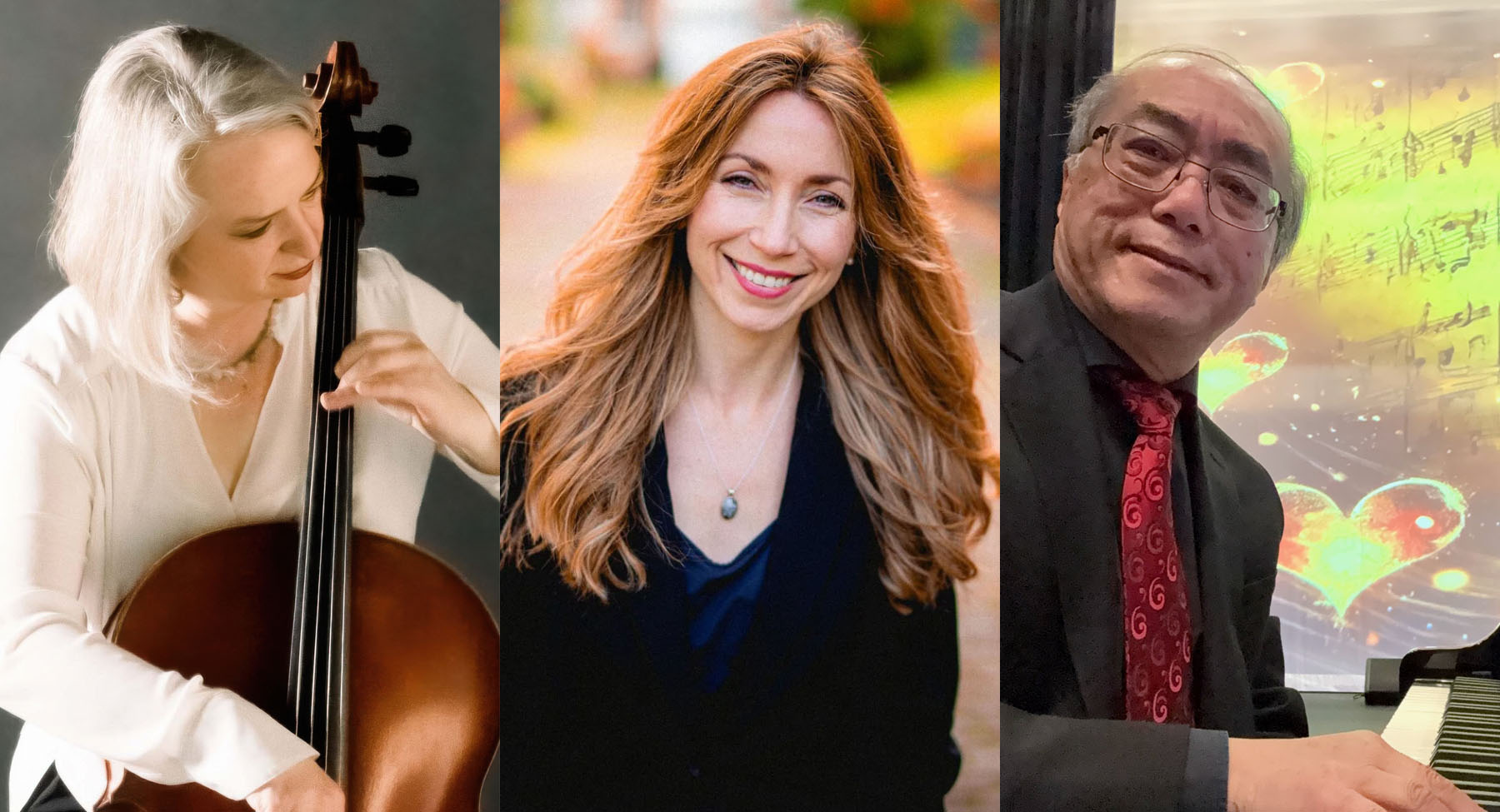
Festival Trio program notes
Ludwig van Beethoven (1770–1827)
Piano Trio in C minor, Op. 1, No. 3
When a twenty-five-year-old composer chooses to stamp “Opus 1” on a set of pieces, he is making a declaration — this is who I am. Beethoven’s three Piano Trios, published in 1795 and dedicated to his Viennese patron Prince Karl von Lichnowsky, were precisely that kind of public statement. Despite the “Opus 1” label, these weren’t his very first compositions; rather, Beethoven deliberately chose them as the works bold and substantial enough to introduce his musical voice to the world. Of the three, the C minor Trio was the controversial one — Haydn himself, after hearing it at a private performance at Lichnowsky’s house, advised Beethoven not to publish it. Beethoven, convinced his teacher was simply jealous, ignored the advice entirely. The public proved him right: it was a sensation.
From the very first phrase, this music announces something new and unsettling. The three instruments launch together in unison — and then, just seven notes in, the theme suddenly slips up a half-step. That single, destabilizing shift sets the emotional tone for everything that follows: impassioned, turbulent, and searching. This is unmistakably C-minor Beethoven — the same dark, driven world he would later inhabit in the “Pathétique” Sonata and, years later, the Fifth Symphony. The first movement unfolds with intense urgency, its passages of warmth and momentary sweetness always circling back into doubt and conflict.
The second movement offers a welcome breath of warmth. Cast in the sunny key of E-flat major, it presents a beautiful, singing theme followed by five variations. Beethoven was fascinated by the variation form throughout his life, and even here, early in his career, he uses it with remarkable imagination — each variation creates its own distinct mood and character while remaining rooted in the same material. It is music of elegance and quiet grace, a calm center at the heart of an otherwise stormy work.
The third movement is a Minuet — notably, the only one of the three Op. 1 trios to use a minuet here rather than a more modern scherzo. It carries a deliberate, almost ponderous weight in its outer sections, contrasted by a more flowing, lyrical middle portion, before the finale unleashes the tension held in reserve throughout the work. The closing Prestissimo explodes with hammered chords and a relentless, driving energy that rivals the first movement’s intensity. But Beethoven saves his most cunning surprise for the very end: just when you think the music is finally settling home into C minor for a grand conclusion, it takes a sudden detour down to the utterly unexpected key of B minor — before winding its way back with gleeful inevitability. Even the final bars refuse to be predictable, offering a close that few listeners will see coming. This is a young composer already showing the mischievous brilliance and raw power that would define one of the greatest careers in music history.
Michael Conway Baker (1937–2025)
Piano Trio
Michael Conway Baker (1937-2025) was one of the most renowned and prolific composers in Canada. He was born in West Palm Beach, Florida, in 1937 and lived in Canada from 1958. Baker first gained prominence in 1986 when he wrote three pieces for the World Expo ‘86. Held in Vancouver, BC, these pieces included A Fanfare for Expo ‘86, An Island in Space for the United Nations Pavilion and music for the BC Pavilion.
In 1991, he received a Juno for Best Classical Music Composition for his magnificent Piano Concerto. He was nominated for eleven film awards and received six, including three Genies and an ACTRA Award for Best Score for a television series, David Suzuki’s A Planet For The Taking. He received several major Body of Works Awards and was listed in the 2005 Grove’s Dictionary of Music.
In 1997, he was invested with the Order of British Columbia and received the Queen’s Golden Jubilee Medal. In 2006, he was inducted into the BC Entertainment Hall of Fame. Michael's concert music now comprises over 180 works, including Symphonies, Concertos, full-length Ballets with the National Ballet of Canada and the Royal Winnipeg Ballet, Choral Works, Chamber Music, Fanfares, and music for piano and voice. He has composed more than 250 scores for film and television, including series such as Road to Avonlea, The Nature of Things and The Beachcombers.
Baker characterized his serious music as essentially tonal, reflecting traditional elements of the past while employing 21st-century techniques and approaches. Although tonal, he rarely used key signatures because of his music‘s constantly shifting tonal centres. His music is often evocative and lends itself to extramusical venues such as dance, skating and film.
Although Baker‘s music is essentially traditional, his style is clearly that of a 21st-century composer. He states, simply, that he writes, first and foremost, music that convinces him. If his music was appealing and convincing to others, as it seems to be, he was delighted and pleased. But he stressed his philosophy that convincing music can only come from true conviction, and he urged young composers to follow their personal muse and not the dictates of others.
Baker’s music is characterized by strong, predominantly lyrical emotional expression, which suits his 200 film/TV/video scores well.
In his chamber works, Baker often combines tonal clarity with fresh harmonic colour, crafting music that speaks in clear, songlike phrases while retaining depth and sophistication. In a piano trio, listeners can expect long‑breathed themes that unfold with patience, rooted in melodies that feel immediately communicative. The piano may introduce central motives or harmonic landscapes, while the violin and cello share in the melodic storytelling, sometimes in close dialogue, sometimes in poignant solo moments.
Rhythmically, his music tends to balance gentle propulsion with more reflective passages, allowing the ensemble to inhabit both energetic and contemplative sound worlds. Tender, introspective sections might be followed by more animated episodes, conveying a sense of journey. Throughout, the writing is crafted to be idiomatic and expressive for performers, inviting them to shape phrases with nuance and warmth.
For Canadian audiences, a work like this Piano Trio also carries an additional resonance: it reflects a homegrown voice within a tradition largely shaped in Europe. Heard between Beethoven and Brahms, Baker’s trio offers a distinct perspective—one that bridges Romantic warmth and a 20th‑/21st‑century sensibility, speaking in a musical language that is at once familiar and freshly personal, and now also serves as a tribute to a recently departed composer. It is in two movements—Part 1 and Part 2.
Johannes Brahms (1833–1897)
Piano Trio No. 1 in B major, Op. 8 (revised version, 1889)
What we hear tonight is a work born twice. Brahms first wrote this trio in 1854, at the age of twenty-one, in a rush of youthful passion that followed his electrifying introduction to Robert and Clara Schumann. He set it aside for thirty-five years — then, in the summer of 1889, took it back out and did something almost no major composer had ever done: he rewrote it from the ground up. The revision was thorough and deliberate, cutting the work down by nearly a third, tightening its architecture, and replacing the extravagant emotional outpourings of youth with the concentrated craft of a master at the height of his powers. Brahms presented the revision with characteristic self-deprecating wit, telling a friend he had merely “combed and arranged its hair a little” — but make no mistake, this is essentially a new composition built on the bones of the old one.
The first movement opens with a gesture of disarming simplicity: the piano alone intones a long, warmly arching melody in its rich middle register, as though thinking aloud. In the 1889 revision, Brahms stripped away the sprawling, episodic passages of the original and replaced them with tighter, more purposeful transitions, keeping the music’s emotional arc under firmer control. The result is a movement that breathes more naturally — the surges of passion feel more inevitable, and the moments of tender repose more deeply earned. Where the young Brahms wrote at full volume for much of the movement, the older Brahms knew how much more powerful a whisper can be.
The Scherzo remains almost exactly as Brahms wrote it at twenty-one — the single movement he trusted enough to leave alone. Its pouncing, hunting-call theme, tossed between the three instruments in vigorous dialogue, still crackles with exactly the kind of unbridled energy that the revisions elsewhere reined in. The lush, glowing trio section, with its more lyrical character, offers a moment of contrast before the opening hunt resumes. That Brahms preserved this movement intact speaks volumes: even the seasoned master recognized that some spontaneity is irreplaceable.
The slow movement, the Adagio, carries the most significant gift of the revision. The hushed, chorale-like opening — the piano moving in slow, solemn block chords, almost motionless — was retained from the original and still evokes something timeless and contemplative. But the breathtaking centrepiece of the movement, a long-breathed, aching cello melody of almost unbearable tenderness, was newly composed in 1889. This is the mature Brahms at his most intimate and searching, the melody unfolding over a quietly rocking piano accompaniment before the violin gently takes it up in turn. It is one of the most poignant passages in all of Brahms’s chamber music, and the audience in 1889 would have had no idea it hadn’t been there all along.
The finale is the movement where Brahms’s revisions are felt most dramatically. Where the original finale had been expansive and somewhat diffuse, the 1889 version is leaner and more driven — a brooding, storm-swept movement in B minor that presses forward with relentless rhythmic urgency. The folk-inflected main theme, with its Hungarian rhythmic edge, suggests both the violin music Brahms had loved since his early touring days and the darker emotional undercurrents that preoccupied him in his later years. For all the trio’s warmth and lyricism, the work refuses a triumphant conclusion: the B major promised by the opening movement never fully reclaims the final pages, and the last bars close firmly and defiantly in B minor. It is the ending of a composer who had learned, over a long creative life, that honest endings are rarely tidy ones — and that a little darkness, left unresolved, can be the most truthful thing of all.
A shared journey: the Festival Trio and the piano trio tradition
Heard together, these three works offer a compelling portrait of the piano trio’s expressive possibilities. Beethoven’s C minor trio challenges the Classical model with its dramatic urgency and structural ambition; Michael Conway Baker brings the tradition into a distinctly Canadian voice, his trio now also serving as an in‑memoriam presence on the program; Brahms, in revising his Op. 8, fuses youthful passion with late‑style reflection, creating a chamber work of symphonic depth.
For the Festival Trio, this program is an opportunity to explore different facets of ensemble identity: the fiery interplay demanded by Beethoven, the lyrical narrative and coloristic shading in Baker, and the expansive, layered sound world of Brahms. Across the evening, listeners can trace how three instruments—piano, violin, and cello—continue to reinvent their shared language of dialogue, tension, and lyricism from one era to the next.
Piano Trio in C minor, Op. 1, No. 3
When a twenty-five-year-old composer chooses to stamp “Opus 1” on a set of pieces, he is making a declaration — this is who I am. Beethoven’s three Piano Trios, published in 1795 and dedicated to his Viennese patron Prince Karl von Lichnowsky, were precisely that kind of public statement. Despite the “Opus 1” label, these weren’t his very first compositions; rather, Beethoven deliberately chose them as the works bold and substantial enough to introduce his musical voice to the world. Of the three, the C minor Trio was the controversial one — Haydn himself, after hearing it at a private performance at Lichnowsky’s house, advised Beethoven not to publish it. Beethoven, convinced his teacher was simply jealous, ignored the advice entirely. The public proved him right: it was a sensation.
From the very first phrase, this music announces something new and unsettling. The three instruments launch together in unison — and then, just seven notes in, the theme suddenly slips up a half-step. That single, destabilizing shift sets the emotional tone for everything that follows: impassioned, turbulent, and searching. This is unmistakably C-minor Beethoven — the same dark, driven world he would later inhabit in the “Pathétique” Sonata and, years later, the Fifth Symphony. The first movement unfolds with intense urgency, its passages of warmth and momentary sweetness always circling back into doubt and conflict.
The second movement offers a welcome breath of warmth. Cast in the sunny key of E-flat major, it presents a beautiful, singing theme followed by five variations. Beethoven was fascinated by the variation form throughout his life, and even here, early in his career, he uses it with remarkable imagination — each variation creates its own distinct mood and character while remaining rooted in the same material. It is music of elegance and quiet grace, a calm center at the heart of an otherwise stormy work.
The third movement is a Minuet — notably, the only one of the three Op. 1 trios to use a minuet here rather than a more modern scherzo. It carries a deliberate, almost ponderous weight in its outer sections, contrasted by a more flowing, lyrical middle portion, before the finale unleashes the tension held in reserve throughout the work. The closing Prestissimo explodes with hammered chords and a relentless, driving energy that rivals the first movement’s intensity. But Beethoven saves his most cunning surprise for the very end: just when you think the music is finally settling home into C minor for a grand conclusion, it takes a sudden detour down to the utterly unexpected key of B minor — before winding its way back with gleeful inevitability. Even the final bars refuse to be predictable, offering a close that few listeners will see coming. This is a young composer already showing the mischievous brilliance and raw power that would define one of the greatest careers in music history.
Michael Conway Baker (1937–2025)
Piano Trio
Michael Conway Baker (1937-2025) was one of the most renowned and prolific composers in Canada. He was born in West Palm Beach, Florida, in 1937 and lived in Canada from 1958. Baker first gained prominence in 1986 when he wrote three pieces for the World Expo ‘86. Held in Vancouver, BC, these pieces included A Fanfare for Expo ‘86, An Island in Space for the United Nations Pavilion and music for the BC Pavilion.
In 1991, he received a Juno for Best Classical Music Composition for his magnificent Piano Concerto. He was nominated for eleven film awards and received six, including three Genies and an ACTRA Award for Best Score for a television series, David Suzuki’s A Planet For The Taking. He received several major Body of Works Awards and was listed in the 2005 Grove’s Dictionary of Music.
In 1997, he was invested with the Order of British Columbia and received the Queen’s Golden Jubilee Medal. In 2006, he was inducted into the BC Entertainment Hall of Fame. Michael's concert music now comprises over 180 works, including Symphonies, Concertos, full-length Ballets with the National Ballet of Canada and the Royal Winnipeg Ballet, Choral Works, Chamber Music, Fanfares, and music for piano and voice. He has composed more than 250 scores for film and television, including series such as Road to Avonlea, The Nature of Things and The Beachcombers.
Baker characterized his serious music as essentially tonal, reflecting traditional elements of the past while employing 21st-century techniques and approaches. Although tonal, he rarely used key signatures because of his music‘s constantly shifting tonal centres. His music is often evocative and lends itself to extramusical venues such as dance, skating and film.
Although Baker‘s music is essentially traditional, his style is clearly that of a 21st-century composer. He states, simply, that he writes, first and foremost, music that convinces him. If his music was appealing and convincing to others, as it seems to be, he was delighted and pleased. But he stressed his philosophy that convincing music can only come from true conviction, and he urged young composers to follow their personal muse and not the dictates of others.
Baker’s music is characterized by strong, predominantly lyrical emotional expression, which suits his 200 film/TV/video scores well.
In his chamber works, Baker often combines tonal clarity with fresh harmonic colour, crafting music that speaks in clear, songlike phrases while retaining depth and sophistication. In a piano trio, listeners can expect long‑breathed themes that unfold with patience, rooted in melodies that feel immediately communicative. The piano may introduce central motives or harmonic landscapes, while the violin and cello share in the melodic storytelling, sometimes in close dialogue, sometimes in poignant solo moments.
Rhythmically, his music tends to balance gentle propulsion with more reflective passages, allowing the ensemble to inhabit both energetic and contemplative sound worlds. Tender, introspective sections might be followed by more animated episodes, conveying a sense of journey. Throughout, the writing is crafted to be idiomatic and expressive for performers, inviting them to shape phrases with nuance and warmth.
For Canadian audiences, a work like this Piano Trio also carries an additional resonance: it reflects a homegrown voice within a tradition largely shaped in Europe. Heard between Beethoven and Brahms, Baker’s trio offers a distinct perspective—one that bridges Romantic warmth and a 20th‑/21st‑century sensibility, speaking in a musical language that is at once familiar and freshly personal, and now also serves as a tribute to a recently departed composer. It is in two movements—Part 1 and Part 2.
Johannes Brahms (1833–1897)
Piano Trio No. 1 in B major, Op. 8 (revised version, 1889)
What we hear tonight is a work born twice. Brahms first wrote this trio in 1854, at the age of twenty-one, in a rush of youthful passion that followed his electrifying introduction to Robert and Clara Schumann. He set it aside for thirty-five years — then, in the summer of 1889, took it back out and did something almost no major composer had ever done: he rewrote it from the ground up. The revision was thorough and deliberate, cutting the work down by nearly a third, tightening its architecture, and replacing the extravagant emotional outpourings of youth with the concentrated craft of a master at the height of his powers. Brahms presented the revision with characteristic self-deprecating wit, telling a friend he had merely “combed and arranged its hair a little” — but make no mistake, this is essentially a new composition built on the bones of the old one.
The first movement opens with a gesture of disarming simplicity: the piano alone intones a long, warmly arching melody in its rich middle register, as though thinking aloud. In the 1889 revision, Brahms stripped away the sprawling, episodic passages of the original and replaced them with tighter, more purposeful transitions, keeping the music’s emotional arc under firmer control. The result is a movement that breathes more naturally — the surges of passion feel more inevitable, and the moments of tender repose more deeply earned. Where the young Brahms wrote at full volume for much of the movement, the older Brahms knew how much more powerful a whisper can be.
The Scherzo remains almost exactly as Brahms wrote it at twenty-one — the single movement he trusted enough to leave alone. Its pouncing, hunting-call theme, tossed between the three instruments in vigorous dialogue, still crackles with exactly the kind of unbridled energy that the revisions elsewhere reined in. The lush, glowing trio section, with its more lyrical character, offers a moment of contrast before the opening hunt resumes. That Brahms preserved this movement intact speaks volumes: even the seasoned master recognized that some spontaneity is irreplaceable.
The slow movement, the Adagio, carries the most significant gift of the revision. The hushed, chorale-like opening — the piano moving in slow, solemn block chords, almost motionless — was retained from the original and still evokes something timeless and contemplative. But the breathtaking centrepiece of the movement, a long-breathed, aching cello melody of almost unbearable tenderness, was newly composed in 1889. This is the mature Brahms at his most intimate and searching, the melody unfolding over a quietly rocking piano accompaniment before the violin gently takes it up in turn. It is one of the most poignant passages in all of Brahms’s chamber music, and the audience in 1889 would have had no idea it hadn’t been there all along.
The finale is the movement where Brahms’s revisions are felt most dramatically. Where the original finale had been expansive and somewhat diffuse, the 1889 version is leaner and more driven — a brooding, storm-swept movement in B minor that presses forward with relentless rhythmic urgency. The folk-inflected main theme, with its Hungarian rhythmic edge, suggests both the violin music Brahms had loved since his early touring days and the darker emotional undercurrents that preoccupied him in his later years. For all the trio’s warmth and lyricism, the work refuses a triumphant conclusion: the B major promised by the opening movement never fully reclaims the final pages, and the last bars close firmly and defiantly in B minor. It is the ending of a composer who had learned, over a long creative life, that honest endings are rarely tidy ones — and that a little darkness, left unresolved, can be the most truthful thing of all.
A shared journey: the Festival Trio and the piano trio tradition
Heard together, these three works offer a compelling portrait of the piano trio’s expressive possibilities. Beethoven’s C minor trio challenges the Classical model with its dramatic urgency and structural ambition; Michael Conway Baker brings the tradition into a distinctly Canadian voice, his trio now also serving as an in‑memoriam presence on the program; Brahms, in revising his Op. 8, fuses youthful passion with late‑style reflection, creating a chamber work of symphonic depth.
For the Festival Trio, this program is an opportunity to explore different facets of ensemble identity: the fiery interplay demanded by Beethoven, the lyrical narrative and coloristic shading in Baker, and the expansive, layered sound world of Brahms. Across the evening, listeners can trace how three instruments—piano, violin, and cello—continue to reinvent their shared language of dialogue, tension, and lyricism from one era to the next.